Testing is More Larger Than Just Writing Some Tests
!NOTE I am not a testing expert. I am merely sharing my thoughts on testing as a developer, in an article I would have appreciated when I began coding.
I started coding six years ago. Since then, I've heard a lot about testing, but I have seen few real and practical examples.
In many articles I read, tests look like this:
it('should return 2 when 1 + 1', () => {
  expect(1 + 1).toBe(2)
})
This is far from real-world scenarios and does not help in understanding the true value of testing.
I have to admit, when I don't comprehend something, I avoid using it. Nevertheless, since I first encountered the concept of testing, it has lingered in my mind, prompting me to gather knowledge about it.
A long journey
I first heard about testing when I learned Vue 2 in 2019. In the tooling section, under the "Single File Component" page, I found a section dedicated to "Testing."
I think I read the beginning of the page but never went further. There were too many new concepts to grasp, too many tools to learn, and too many choices to make. At that time, I understood that front-end testing is by far the most challenging part of testing.
In 2020, with some friends, we developed a tutoring platform. The API server was built with Feathers.js 4. At that time, I was still grappling with testing. I remember looking for the testing page in the Feathers.js documentation and even reading it. Despite not fully understanding it, I wrote many tests. It was a real struggle because the distinction between unit tests and integration tests was unclear to me, and running them in a CI was very difficult. I was using MongoDB and Azure CI. Looking back, I think I wanted to endure pain. I also remember trying to achieve 100% coverage. I was so naive.
it('should patch', async () => {
  expect.assertions(5)

  const patchedResult: Department = await app
    .service(serviceName)
    .patch(result._id, anotherDepartment)

  expect(patchedResult).toBeDefined()
  expect(patchedResult).toHaveProperty('_id')
  expect(patchedResult).toHaveProperty(
    'name',
    anotherDepartment.name.toLowerCase()
  )
  expect(patchedResult).toHaveProperty('createdAt')
  expect(patchedResult).toHaveProperty('updatedAt')
})

it('should delete', async () => {
  expect.assertions(5)

  const deleteResult: Department = await app
    .service(serviceName)
    .remove(result._id)

  expect(deleteResult).toBeDefined()
  expect(deleteResult).toHaveProperty('_id')
  expect(deleteResult).toHaveProperty('name', result.name.toLowerCase())
  expect(deleteResult).toHaveProperty('createdAt')
  expect(deleteResult).toHaveProperty('updatedAt')
})
But the more I added features to the platform, the more I realized the value of testing. It can ensure that a new feature does not break an existing one without the hassle of manually testing everything. This was particularly evident because Feathers.js has many intricate parts and services that can easily break when one part is modified.
export default {
  before: {
    all: [],
    find: [],
    get: [],
    create: [checkData(checkDataOptions)],
    update: [disallow()],
    patch: [checkData(checkDataOptions)],
    remove: [],
  },

  after: {
    all: [],
    find: [iff(isProvider('external'), pickResult())],
    get: [iff(isProvider('external'), pickResult())],
    create: [],
    update: [],
    patch: [],
    remove: [],
  },
}
The complexity of the app grew exponentially, feature after feature. This was more related to the architecture of Feathers.js, but combined with the challenges of writing efficient tests, it was a nightmare to maintain. Each change broke so many tests that I was unsure if the app was working or not.
From that point on, I decided the ability to test the app was a requirement for choosing a new stack. And this will be a long journey because in 2024, I'm still learning a lot but writing more tests than ever.
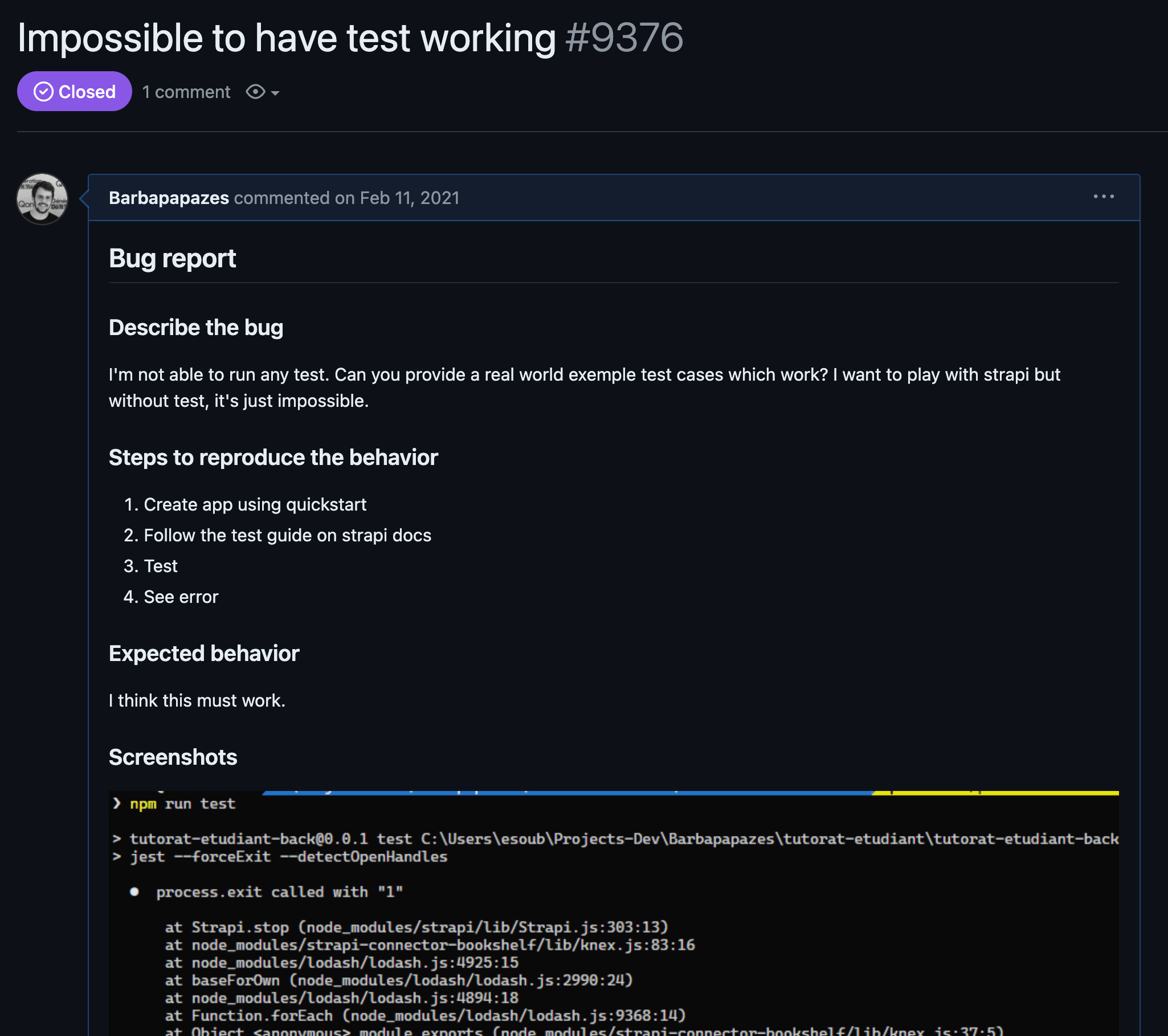
At the beginning of 2021, Strapi was gaining popularity, and I looked at it as a potential replacement for Feathers.js, still to build the tutoring platform. I was pleased to see that Strapi has a dedicated page for testing in the documentation.
So, I jumped in and created a new project with Strapi to get started and see if testing was effective.
Sadly, I immediately encountered a problem that never got resolved. Unable to run tests, I gave up and the tutoring platform was never migrated to Strapi, nor deployed to production. I learned a lot from this side project. Often, the journey is more important than the destination.
So let's recap:
- I only know JavaScript.
- Feathers.js has a complex architecture and poor documentation on testing.
- Strapi has good documentation on testing, but I was unable to run tests.
- I need to find a new side project to learn testing.
Some months later, I heard about AdonisJS. I don't remember how, but at that time, version 5 was in beta. It was a breath of fresh air because the documentation looked very good, and the framework was rich in features. Full of features, yes, but the testing part was not there yet. The core team released Japa a year later. It's a pleasant testing framework for Node.js.
Regardless, I learned so much about backend development and architecture with AdonisJS that testing was clearly not a priority. This was the first time I could split features and avoid internal dependencies. Much cleaner and easier to maintain than Feathers.js or NestJS. Yes, I also tried NestJS, but this framework is a real joke to me.
By the end of August 2021, I embarked on a new side project called Insamee, a student ecosystem. That was the successor of the tutoring platform. The architecture is important to clarify. Initially, it was an API server with AdonisJS and four front-end apps using Nuxt. Overkill and overly complicated, as I realize now.
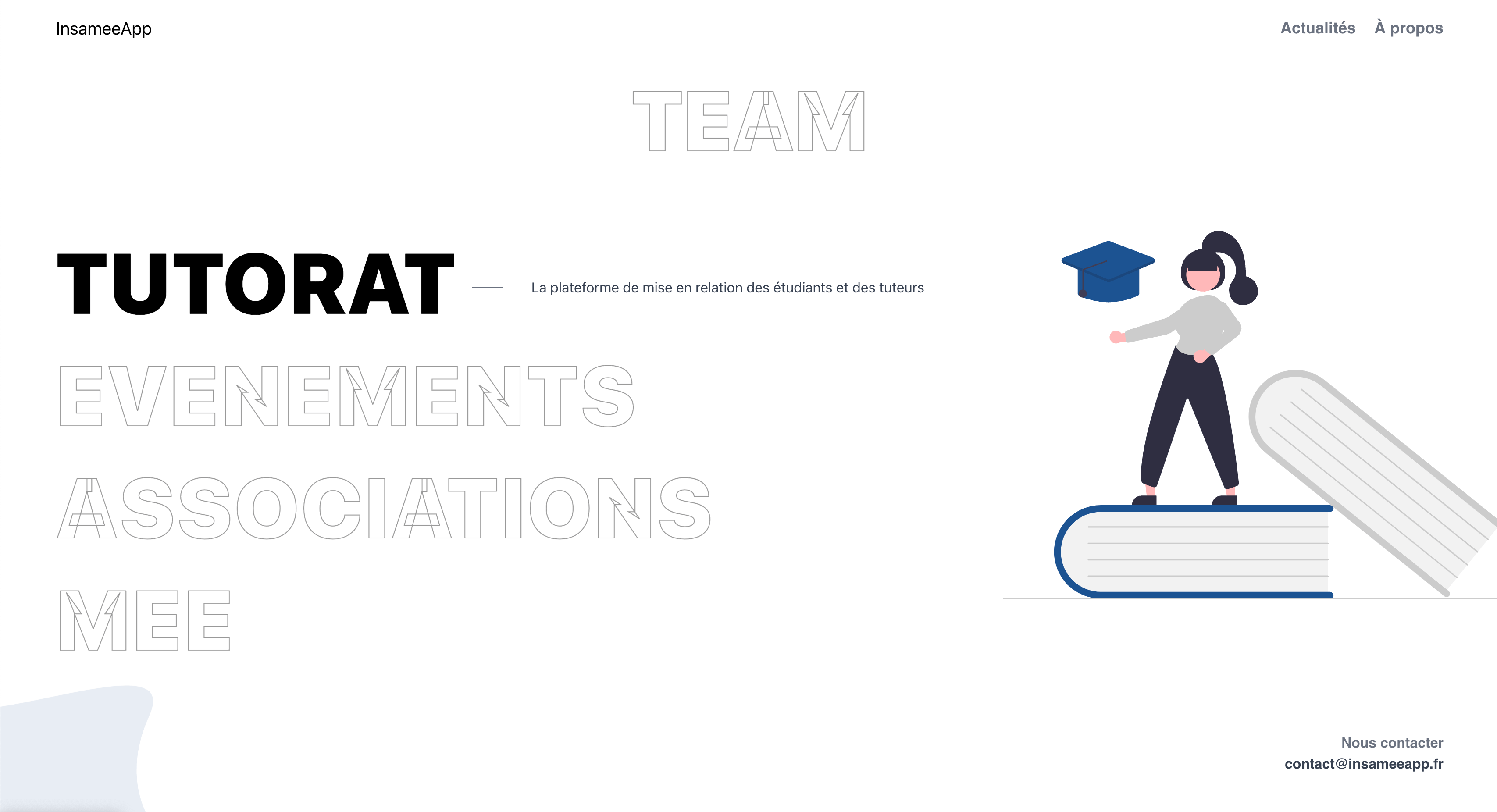
By the end of 2021, I rewrote the project from scratch using only Adonis and a single server. No more tests.
I managed to pull myself away from school classes to focus on my project. A real opportunity. To validate my semester, I had to write a report and make a live presentation. During the presentation, I didn't talk about testing (there were none). However, the jury questioned me about it. I just said the runner was not ready yet, so I hadn't written any tests. They took a few minutes to explain that testing is crucial, and I clearly understood that a real and professional project must have tests, it's non-negotiable. In my mind, something clicked.
Subsequently, from April to August 2022, I did a four-month internship at a consulting company in Paris. I was responsible for building, from scratch, an administration panel for a high-performance computing cluster project using Angular 14. This was a first for me. I had never used Angular before. It took me months to grasp the concept of TestBed and the dependency injection (DI) system. I was so lost, but later, I discovered that dependency injection is important. During that period, I learned concepts but had no real practice.
In 2024, I did my six-month internship at a Swiss cloud company. I was part of a team developing components for other projects. This is where I truly began to appreciate testing. Firstly, the coverage was at 90%. This means if the coverage drops below 90%, you have no other choice than to write tests to submit an MR. The project was eight months old, so there were plenty of tests to reference. I also wrote many end-to-end tests using Playwright.
Simultaneously, I watched a live stream by Romain Lanz discussing "writing testable code" and explaining the DI in Adonis. With these explanations and the concrete examples I encountered during my internship, things started to come together and make sense.
This year, at Devoxx 2024, I tried to attend as many talks about TDD and DDD as possible. Hearing experts discuss real-world examples and how they architect their apps to make them testable and future-proof was truly enlightening.

Thanks for reading! My name is Estéban, and I love to write about web development and the human journey around it.
I've been coding for several years, and I'm still learning new things every day. I share what I learn because I would have appreciated clear and complete resources when I started programming.
If you have a question or want to chat, leave a comment below or reach out through my social profiles.
I hope you learned something useful. Share the article, leave a comment, or add a reaction if you did. Support my work on GitHub.
Follow me
Estéban Soubiran
Software engineer, conference speaker, and open source enthusiast.
Discussions
Loading discussions...
Add a comment
Checking your session...